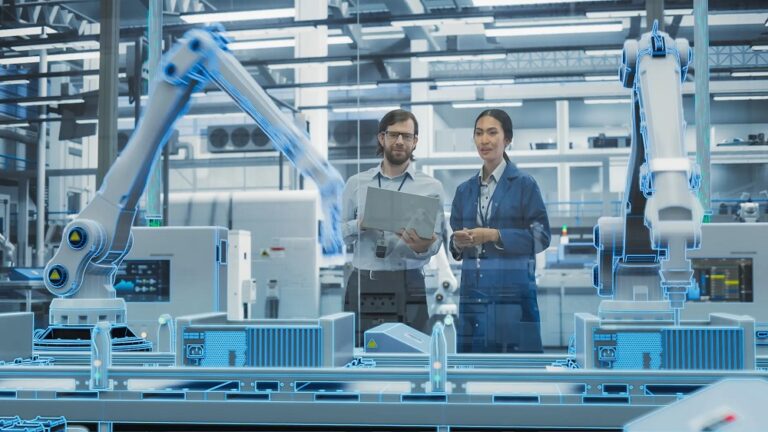
The global manufacturing sector is undergoing an industrial transformation that rivals the introduction of steam power, assembly lines, and early automation. Traditional, isolated production facilities are rapidly evolving into highly integrated ecosystems. This shift is commonly referred to as the Fourth Industrial Revolution, or Industry 4.0, and at its absolute center is the rise of the smart factory.
A smart factory is a manufacturing facility that leverages interconnected digital technologies to create a fully automated, self-optimizing production environment. Unlike traditional factories that rely on manual supervision and rigid machinery, connected manufacturing relies on the continuous flow of data to improve efficiency, reduce waste, and adapt instantaneously to changing market demands. This article explores the underlying technologies driving this movement, the operational advantages of connected ecosystems, and the challenges companies must overcome to modernize their operations.
The Core Technological Pillars of Smart Factories
The intelligence of a modern factory does not stem from a single machine or software program. Instead, it relies on a complex network of advanced technologies working together to bridge the gap between physical machinery and digital intelligence.
The Industrial Internet of Things
The Industrial Internet of Things forms the nervous system of the smart factory. It involves embedding internet-connected sensors, actuators, and meters directly into manufacturing equipment, assembly lines, and raw material shipments.
These sensors continuously gather real-time data regarding a machine’s temperature, vibration, operational speed, and energy consumption. By connecting legacy hardware to a centralized digital network, companies can extract actionable insights from devices that were previously completely silent. This constant stream of telemetry provides operators with unprecedented visibility into every stage of the production lifecycle.
Big Data Analytics and Cloud Computing
The massive influx of information generated by thousands of shop-floor sensors is only valuable if it can be processed and analyzed efficiently. This is where cloud computing and big data analytics enter the equation.
Smart factories utilize specialized cloud platforms to aggregate and store vast datasets. Advanced analytics software then processes this information to identify subtle patterns, correlations, and anomalies that escape human notice. Operators can use these insights to evaluate historical production runs, identify operational inefficiencies, and make data-driven decisions that fine-tune production outputs.
Artificial Intelligence and Machine Learning
While basic data analytics can highlight past performance, artificial intelligence and machine learning allow systems to predict and adapt to future events. Machine learning algorithms use the continuous stream of sensor data to learn the optimal operating conditions of specific machinery.
Once trained, these AI models can autonomously adjust manufacturing variables, such as modifying the cutting speed of a CNC machine to account for material density variations. This level of automation shifts the manufacturing environment from a reactive state to a proactive, self-correcting ecosystem.
Advanced Robotics and Autonomous Systems
Robots have been a staple of automotive and heavy industry for decades, but modern smart factory robotics are fundamentally different. Traditional industrial robots operate in protective cages, executing highly repetitive tasks with zero awareness of their surroundings.
Connected manufacturing utilizes collaborative robots, often called cobots, and Autonomous Mobile Robots. Cobots feature advanced proximity sensors that allow them to work safely alongside human operators without physical barriers, while autonomous mobile robots navigate warehouse floors independently to transport components between assembly lines, eliminating manual material handling and streamlining factory logistics.
Operational Advantages of Connected Manufacturing
Investing in smart factory infrastructure yields substantial strategic benefits, allowing manufacturers to drastically cut overhead while expanding their output capabilities.
Transitioning to Predictive Maintenance
In traditional manufacturing environments, maintenance follows two costly paths: reactive maintenance, where machines are run until they break down, causing unexpected downtime, or preventive maintenance, where parts are replaced on a fixed schedule regardless of their actual wear, resulting in wasted resources.
Smart factories solve this issue through predictive maintenance. By continuously monitoring vibration and thermal signatures, AI systems can accurately predict exactly when a component is nearing catastrophic failure. Maintenance teams can then schedule repairs during planned shift changes or low-demand windows, minimizing production disruptions and maximizing the lifespan of capital equipment.
Unprecedented Mass Customization
Historically, factories achieved profitability through economies of scale, mass-producing millions of identical products to minimize the setup costs of production lines. If a customer required a custom variation, reconfiguring the physical machinery required hours or days of manual retooling.
Connected manufacturing enables mass customization. Because the assembly lines are driven by software and adaptive robotics, a facility can switch production parameters instantaneously. A single assembly line can produce a batch of customized medical devices followed immediately by a standard consumer variant, without stopping the machinery for a manual reset. This agility allows brands to serve niche markets profitably.
Enhanced Supply Chain Synchronicity
A smart factory does not operate in an isolated bubble. Its digital network integrates directly with enterprise resource planning systems, raw material suppliers, and third-party logistics providers.
When the shop-floor management software detects that production speeds are consuming raw steel faster than anticipated, it can automatically issue an authorized purchase order to the material supplier. This end-to-end connectivity minimizes warehouse inventory holdings, prevents production bottlenecks caused by component shortages, and ensures that fulfillment teams are aware of exact completion timelines.
Overcoming Challenges in the Transition to Smart Manufacturing
Despite the clear benefits, transitioning a legacy manufacturing footprint into a fully connected digital ecosystem introduces significant technological and organizational obstacles.
Bridging the IT and OT Divide
One of the greatest operational friction points during a smart factory rollout is the convergence of Information Technology and Operational Technology.
-
Information Technology: Focuses on corporate data systems, software networks, and business intelligence.
-
Operational Technology: Focuses on the physical hardware, programmable logic controllers, and safety systems of the factory floor.
Historically, these two departments operated in silos with entirely different priorities, communication protocols, and security requirements. Integrating legacy industrial machinery with modern corporate networks requires cross-disciplinary training and the implementation of unified communication protocols to ensure data flows securely and reliably.
Elevated Cybersecurity Vulnerabilities
Connecting industrial machinery to the internet introduces substantial cybersecurity risks. Legacy manufacturing equipment was designed decades ago with a focus on durability and physical safety, completely omitting digital security or encryption frameworks.
Exposing these vulnerable devices to external networks creates opportunities for malicious actors to execute cyber espionage, intellectual property theft, or ransomware attacks that halt entire assembly lines. Manufacturers must adopt zero-trust architectures, isolate operational networks from standard office networks, and deploy robust endpoint encryption to secure their physical infrastructure from digital threats.
Frequently Asked Questions
What is the distinction between automation and a true smart factory?
Basic automation involves a machine executing a pre-programmed, repetitive task without variance, such as a robotic arm welding a specific car door frame. A smart factory goes beyond simple automation by introducing interconnectivity and learning capabilities. Smart systems gather data from multiple points across the entire facility, analyze that data to understand wider operational contexts, and autonomously adjust their own behaviors to optimize the broader production environment.
How do digital twins function within a connected manufacturing environment?
A digital twin is a highly precise, virtual representation of a physical asset, production line, or entire factory floor. By feeding real-time sensor data from the physical factory into the digital twin software, engineers can simulate and visualize current operational states. This allows management to run hypothetical tests, model process adjustments, and identify potential workflow bottlenecks virtually before altering physical equipment on the actual shop floor.
Can legacy factories modernize without buying entirely new machinery?
Yes, legacy factories can transition to smart manufacturing without replacing their existing capital equipment. This process is known as brownfield modernization. Companies can retrofit older, manual machines with non-invasive external sensors, specialized data-acquisition modules, and modern gateway controllers. This allows the business to capture and transmit valuable telemetry from older assets at a fraction of the cost of buying new machinery.
How does the rise of smart factories affect human manufacturing jobs?
The transition to smart factories changes the nature of manufacturing labor rather than eliminating it entirely. While manual, repetitive material handling and simple assembly tasks are increasingly automated, demand rises significantly for skilled human workers who can program, maintain, and manage complex digital systems. Roles shift toward data analysis, robotic maintenance, cybersecurity control, and continuous process optimization.
What role does 5G connectivity play in the development of smart factories?
5G connectivity provides the high bandwidth, low latency, and massive device density required to run complex smart factories. Traditional wireless networks can struggle to maintain reliable connections when thousands of sensors and autonomous vehicles are communicating simultaneously across a vast industrial warehouse. 5G ensures that critical machine-to-machine data transfers occur in milliseconds, enabling real-time precision control of mobile robotics.
How do smart factories contribute to corporate sustainability initiatives?
Smart factories improve sustainability by drastically reducing raw material waste and energy consumption. Sensors monitor the energy usage of individual machines, allowing AI systems to power down inactive hardware or schedule energy-intensive operations during off-peak utility pricing hours. Furthermore, precise quality control systems spot material defects early in the production cycle, preventing the wasteful processing of scrap material.
What is edge computing, and why is it necessary in manufacturing?
Edge computing is the practice of processing data locally on the factory floor, near the physical machines generating it, rather than sending all raw sensor data to a distant centralized cloud server. This localized processing is essential for manufacturing applications that require instantaneous feedback, such as triggering an emergency safety stop when a sensor detects an irregular vibration spike. Edge computing reduces latency and prevents network bandwidth overload.